The Ultimate Checklist for Car Interior Salt Stain Removal in Orangeville

Did you know that Ontario spreads between 2 and 3 million tonnes of road salt across our roads every single winter? That is nearly half of the entire country's total usage. A significant portion of that abrasive white crust inevitably ends up embedded in your vehicle's floorboards and upholstery. While many drivers attempt to scrub these marks away at home, professional mobile car seat shampooing in Orangeville is often the only way to truly neutralize the minerals before they cause permanent damage.
It is incredibly frustrating to watch those stubborn white outlines reappear just days after you thought you cleaned them. We understand the anxiety of seeing your carpets stiffen and the fear that salt is quietly corroding your metal floorboards. This guide will help you master the extraction process to effectively remove Ontario road salt, ensuring your investment is protected and your cabin feels fresh again. You will learn why salt is so difficult to eliminate, how to avoid the lingering smell of DIY vinegar treatments, and the exact steps needed to maintain a salt-free interior throughout the season.
Key Takeaways
Understand the chemical bond between calcium chloride crystals and synthetic fibres to effectively break down stubborn white deposits.
Discover why professional mobile car seat shampooing in Orangeville is necessary to extract salt from the bottom 80% of your carpet that standard vacuums miss.
Master the professional sequence of dry vacuuming and mechanical agitation to remove debris before it turns into a permanent stain.
Identify the risks of DIY methods, specifically how over-wetting can lead to hidden floorboard corrosion and unpleasant musty smells.
Learn how to utilize high-quality rubber mats and regular under-mat maintenance to safeguard your vehicle's interior for the long term.
Table of Contents
The Science of Salt: Why Ontario Winters are Brutal on Your Interior
Ontario winters are notorious for more than just heavy snowfall. The chemical substances used to keep our roads safe are remarkably aggressive toward vehicle interiors. Understanding The Science of Road Salt reveals that these minerals don't just sit on top of your carpet; they actively bond with it. Traditional rock salt consists of large crystals that can be physically removed, but modern liquid brines are designed to stick to surfaces, making them much harder to extract without professional intervention.
When calcium chloride or sodium chloride enters your vehicle, it isn't just simple dirt. As the moisture evaporates, the salt forms jagged, microscopic crystals. These crystals "hook" into the synthetic loops of your carpet fibres, creating a physical bond that resists standard suction. This is why a quick pass with a shop vac rarely solves the problem. To truly clear the area and protect the material, you need the deep thermal extraction provided by mobile car seat shampooing Orangeville services.
Beyond the visual eyesore, salt presents a hidden danger to the structural integrity of your vehicle. Salt is hygroscopic, meaning it naturally pulls moisture from the air. Even on a dry day, the salt embedded in your carpets is drawing in humidity, keeping the area beneath your mats damp. This constant moisture, combined with the corrosive nature of the minerals, creates a perfect environment for floorboard rust to develop unseen beneath the fabric layers.
The "Ghost Stain" Phenomenon
Many drivers feel frustrated when a salt stain reappears shortly after they've scrubbed it away. This occurs because of a process called wicking. When you use a damp cloth to surface-clean, the salt dissolves and travels deeper into the carpet backing. As the carpet dries, the salt solution is pulled back to the surface through capillary action. It then re-crystallizes into that familiar white crust. Improper cleaning doesn't remove the salt; it simply moves it deeper into the upholstery.
Road Brine vs. Rock Salt in Dufferin County
Local municipalities in Dufferin County, especially along high-traffic routes like Highway 10, increasingly rely on liquid brine pre-treatments. These solutions often contain "tackifiers" designed to help the salt stick to the pavement. Unfortunately, these additives also help the brine stick to your shoes and upholstery with incredible tenacity. These modern mixtures are significantly more corrosive than traditional rock salt. Effective removal requires neutralizing the PH level of the carpet to break the chemical bond, a step that is often overlooked in standard DIY attempts.
Essential Tools for Professional-Grade Salt Extraction
Achieving professional results requires more than just a standard cleaning kit. While a household vacuum is designed for dust and pet hair, it lacks the static lift required for heavy salt deposits. A high-powered shop vac is essential. It provides the cubic feet per minute (CFM) of airflow needed to pull moisture and dissolved solids from deep within the carpet pile. Without this level of suction, you're merely moving the salt around rather than removing it from the vehicle.
A stiff-bristled nylon brush is another non-negotiable tool for any Dufferin County driver. It provides the mechanical agitation necessary to break the "crust" of salt deposits. Without this physical breakdown, your cleaning solution cannot reach the core of the minerals. When you are ready to blot the area, microfibre towels are far superior to paper towels. Their increased surface area and unique loop structure allow them to trap and hold the salt brine rather than just spreading it across the surface. Choosing a professional mobile car seat shampooing Orangeville service guarantees that these industrial tools are used correctly on your upholstery.
For the solution itself, many homeowners use a 1:1 ratio of white vinegar and water. While this can work, professional PH-neutralizers are far more effective. They are formulated to target calcium chloride specifically without leaving a pungent odour in your cabin. Using distilled water is a meticulous choice that prevents you from adding extra minerals from hard tap water back into the carpet. If the process seems daunting, scheduling mobile car seat shampooing Orangeville ensures these professional-grade tools are brought directly to your driveway.
The Power of Steam Cleaning
High-temperature steam is a definitive solution for winter buildup. It liquefies crystallized salt instantly. This allows for immediate extraction without the need for excessive scrubbing. Steam is also much safer for delicate automotive adhesives than traditional soaking. Excessive water can cause carpet delamination or musty smells. This level of technical care is a central component of the Full Interior Package. Industrial-grade steam ensures a deep clean while protecting the structural integrity of your upholstery.
Chemical Neutralizers and Softeners
To break the chemical bond of calcium chloride, specific acidic agents are required to lower the PH level of the carpet. You should avoid high-PH soaps. These products leave a sticky residue that acts as a magnet for future dirt and grime. A professional-grade softener ensures the fibres remain supple and soft rather than becoming brittle from salt exposure. If you want to ensure your vehicle receives this level of meticulous attention, a Full Interior Package is an excellent way to protect your investment for the long term.
Step-by-Step Salt Stain Removal Checklist
Executing a professional salt extraction requires a disciplined, systematic approach. If you rush the process or skip steps, you risk turning dry salt into a liquid brine that penetrates even deeper into your vehicle's floorboards. By following this meticulous checklist, you can ensure that every mineral deposit is neutralized and removed rather than just redistributed. This methodical workflow is exactly what you can expect from a high-quality mobile car seat shampooing Orangeville service.
Dry Vacuuming: Begin by removing all loose debris and surface salt. Use the crevice tool of a high-powered shop vac to reach into the tightest corners. Introducing moisture before this step creates a salty sludge that is significantly harder to extract.
Agitation: Use a stiff-bristled nylon brush to break up the "crust" of the salt deposit. Work in multiple directions to loosen the bond between the crystals and the synthetic carpet fibres. This mechanical action is essential for allowing your cleaning solution to penetrate the core of the stain.
Dissolving: Apply your PH-neutralizing solution directly to the affected area. Allow for a dwell time of three to five minutes. This period is critical; the chemistry needs time to break the bond of the calcium chloride.
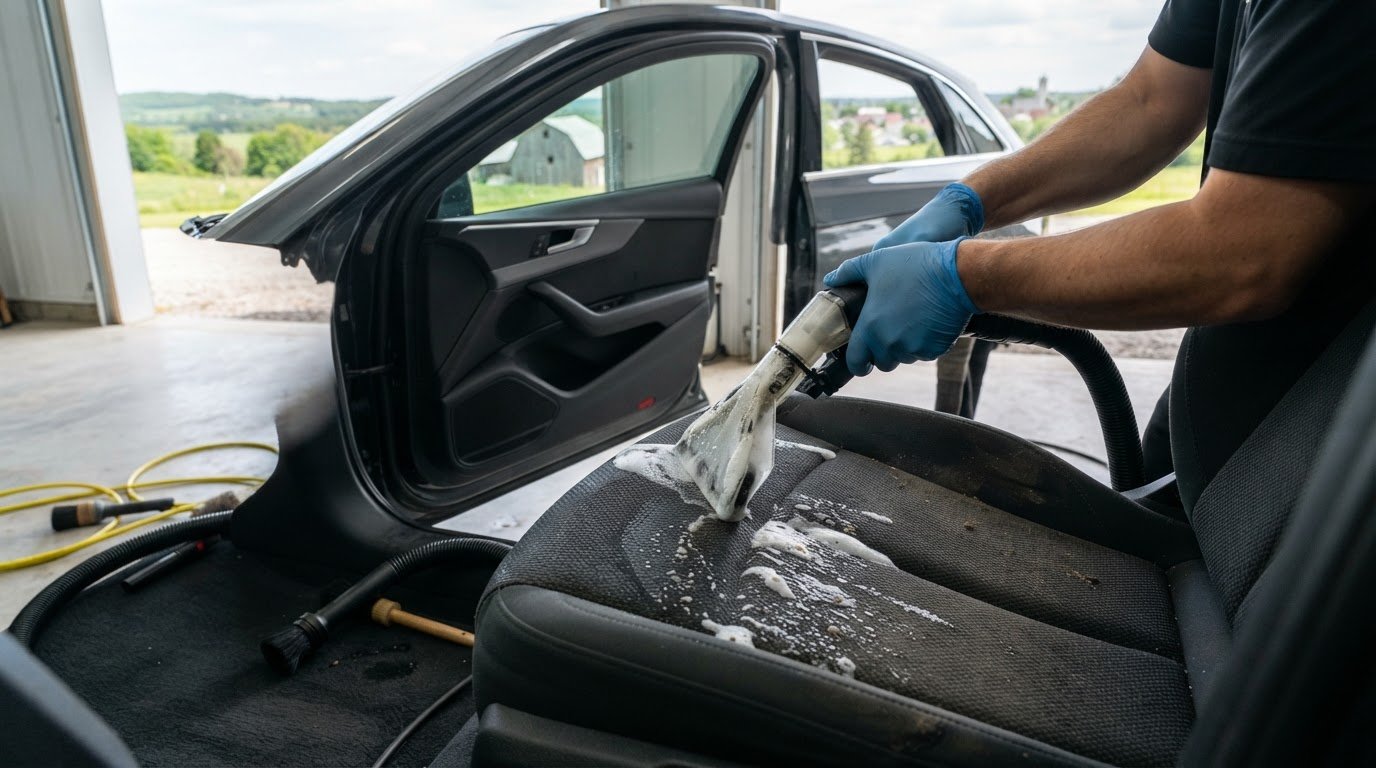
Extraction: Use a dedicated extractor or a powerful wet-dry vacuum to pull the liquefied salt out of the fibres. For deep-set stains, mobile car seat shampooing Orangeville professionals use industrial extractors that provide the necessary lift to clear the bottom layers of the carpet.
Drying: Ensure the area is completely dry before replacing your floor mats. Residual moisture can lead to mold, mildew, and a musty cabin odour that is difficult to eliminate.
The "Blot, Don’t Scrub" Rule
While it is tempting to scrub aggressively at a stubborn white mark, doing so often causes permanent damage. High-friction scrubbing frays the delicate synthetic loops of automotive carpeting, leading to "fuzzing" that cannot be repaired. Instead, focus on lifting the dissolved brine by pressing a clean microfibre towel firmly into the carpet. The blotting technique is the safest method to transfer moisture and salt into the towel without compromising the structural integrity of the carpet fibres.
Dealing with Thick Salt Crust
In Dufferin County, it is common to find salt deposits that are more than 5mm thick. When salt reaches this level of buildup, standard cleaning sprays often fail to reach the bottom layer. You can use the "hot towel" method by placing a microfibre cloth soaked in very hot water over the deposit for several minutes. This softens the salt through thermal transfer without over-saturating the entire floorboard. If the crust remains solid after two attempts, it is a clear signal that a standard vacuum will not suffice and professional-grade extraction is required to protect your vehicle's floorboards from corrosion.
Professional Extraction vs. DIY: When to Call the Experts
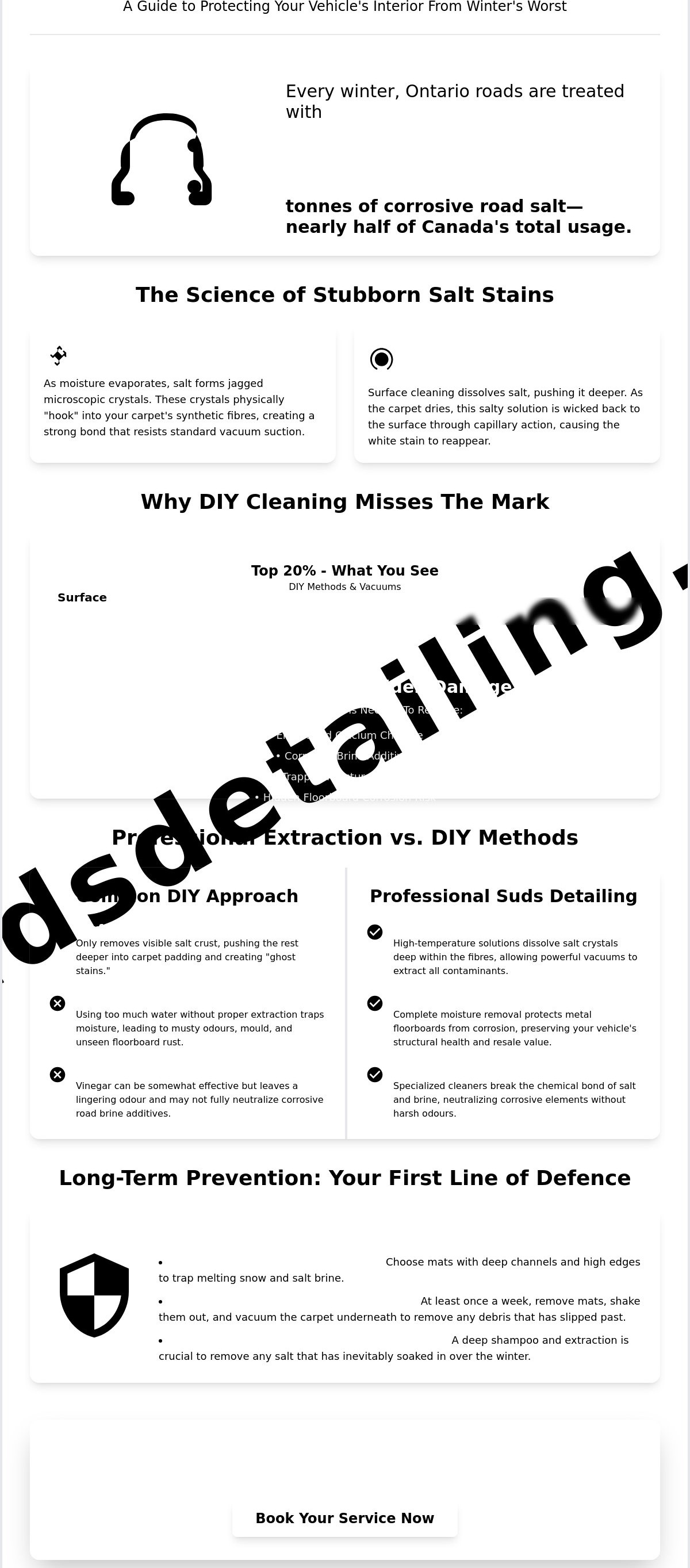
While the checklist provided in the previous section offers a reliable path for maintenance, there is a significant technical gap between surface cleaning and deep-fibre extraction. DIY attempts frequently result in "over-wetting," a common error where excess water seeps into the foam underpad. This trapped moisture often leads to persistent musty odours and, in severe cases, the growth of mold beneath the carpet. Professional mobile car seat shampooing Orangeville utilizes controlled moisture levels and high-heat extraction to ensure the fabric is sanitized without being saturated.
A standard shop vac is a powerful tool for loose debris, but it typically only pulls minerals from the top 20% of the carpet pile. The remaining 80% is where the most damaging salt crystals reside, tucked deep within the backing. Professionals use industrial-grade extractors that reach the root of the fibre. These machines pull out the dissolved brine that a household unit simply cannot reach. This depth of clean is what truly protects your vehicle's floorboards from long-term corrosion and structural degradation.
Consider the value of your time and the protection of your asset. A thorough DIY salt removal session can easily consume four hours of your weekend, often with mediocre results that leave white rings behind. A professional mobile service can achieve a superior finish in about 90 minutes. Beyond the time saved, professional detailing is a strategic investment. Maintaining a pristine, salt-free interior significantly bolsters the resale value of your vehicle, ensuring you get the maximum return when it comes time to trade it in or sell it privately.
The Cost of "Cheap" DIY Mistakes
Using the wrong chemicals can be an expensive error. High-PH cleaners or household detergents can bleach dark automotive carpets or leave a sticky residue that attracts even more grime. If salt is allowed to sit or is pushed deeper into the backing during a failed cleaning attempt, it can eventually reach the metal floorboard or sensitive electrical harnesses. Replacing a salt-damaged harness or repairing floorboard rust can cost thousands of dollars. Professional-grade extractors are the only reliable way to reach the root of the stain and prevent this hidden damage.
Orangeville’s Mobile Advantage
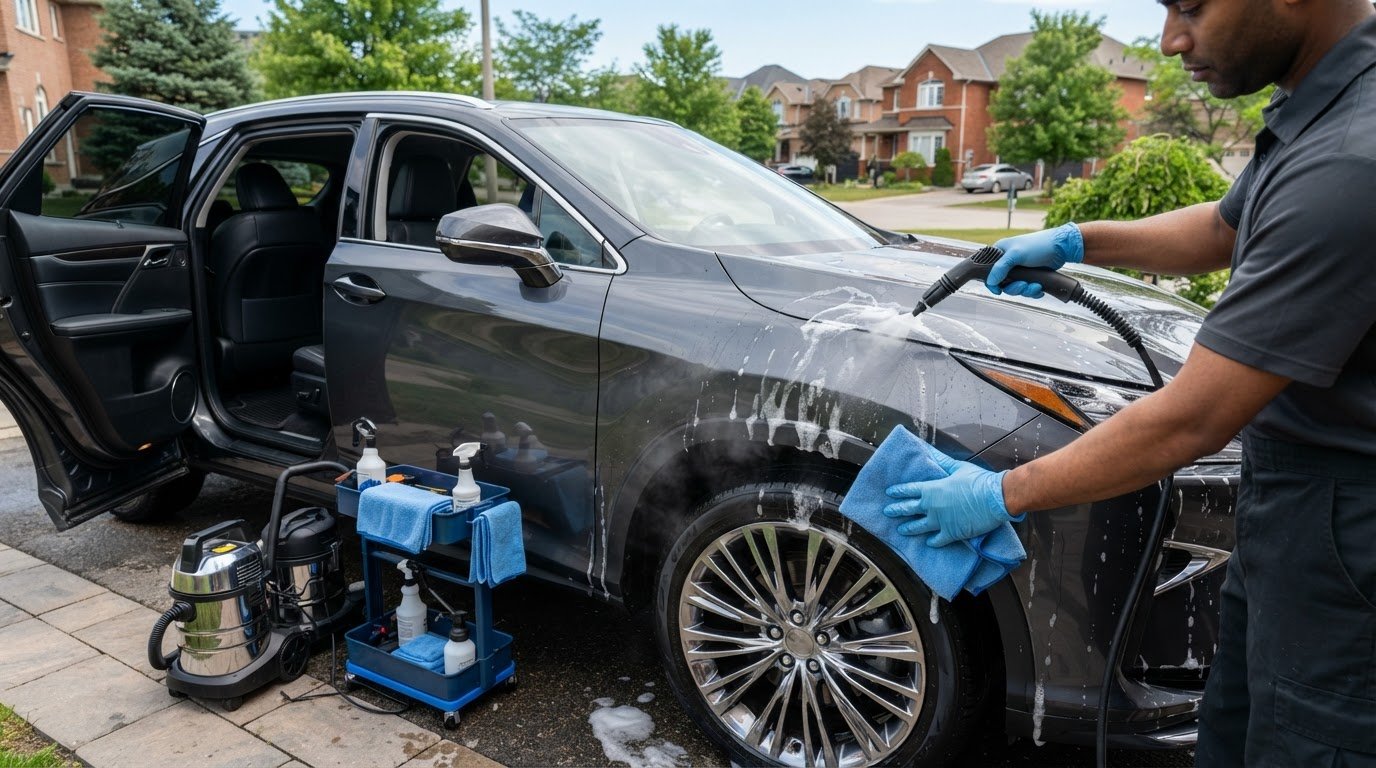
For busy professionals in Dufferin County, the convenience of Mobile Car Detailing Orangeville is unmatched. We bring the equipment, the expertise, and the industrial-grade PH-neutralizers directly to your home or office. This mobile approach means you don't have to drive your freshly cleaned car back onto salty Orangeville roads immediately after the service. You can remain productive or relax while we meticulously restore your interior to its original condition. To ensure your vehicle receives this level of expert care, you can book a Full Interior Package today.
Preventive Care: Keeping Your Cabin Salt-Free All Season
While professional extraction restores your interior to its original condition, a proactive strategy ensures that the aggressive white crust never takes hold in the first place. Protecting your vehicle throughout an Ontario winter requires a combination of high-quality barriers and a consistent maintenance rhythm. By implementing a "Pre-Winter Shield" before the first snowfall, you create a hydrophobic barrier that prevents liquid brine from soaking into the carpet pile. This simple step makes future mobile car seat shampooing Orangeville sessions much more effective, as the salt remains on the surface rather than nesting in the backing.
Investment in high-quality, laser-measured rubber mats is the most effective way to intercept salt before it touches your upholstery. Brands like WeatherTech have become the industry standard because they act as a reservoir for melting snow and corrosive brine. However, even the most expensive mats are not a "set and forget" solution. Salt-water frequently overflows the edges or seeps through the mounting holes, reaching the carpet underneath. You should lift your mats at least once a month to inspect for hidden moisture. If you discover salt starting to crystallize, scheduling mobile car seat shampooing Orangeville immediately will prevent the minerals from hardening into a permanent bond.
A regular maintenance schedule with a local mobile detailer is the final piece of the preventive puzzle. Instead of waiting for a massive buildup in April, a mid-winter cleaning removes the bulk of the salt before it can begin corroding your floorboards. This methodical approach keeps your cabin air fresh and ensures that your vehicle's interior remains a premium environment, regardless of the conditions on Highway 10.
Choosing the Right Winter Mats
When selecting mats, "deep dish" rubber designs are vastly superior to standard carpeted or flat rubber options. A deep-dish mat features high sidewalls that contain the sloshing brine during turns and sudden stops. It is vital to ensure your mats are properly fitted to your specific make and model to prevent runoff. Pay special attention to the "dead pedal" area where your left foot rests; this is a high-traffic zone where salt often accumulates and bypasses poorly fitted mats.
The Value of Fleet Maintenance for Orangeville Businesses
For local businesses operating in Dufferin County, maintaining a clean fleet is about more than just appearance. It is a critical strategy for asset protection. Work vehicles are exposed to extreme salt levels, and allowing that salt to sit leads to rapid depreciation and potential electrical issues. Regular professional cleaning prevents long-term damage and ensures your company vehicles project a professional image to your clients. You can effectively protect your fleet this winter with Suds Detailing Fleet Services, ensuring your work vehicles remain in peak condition year-round.
Restore Your Vehicle’s Interior and Protect Your Investment
Master the art of salt extraction by shifting from surface scrubbing to a systematic chemical neutralization process. We have explored how specialized steam cleaning technology liquefies stubborn brine instantly, preventing the permanent fibre damage and floorboard corrosion that often follow a DIY attempt. By prioritizing professional mobile car seat shampooing Orangeville, you ensure that the deepest layers of your upholstery are cleared of calcium chloride before they can compromise your vehicle's structural integrity.
Our expertise in Ontario winter vehicle care allows us to bring industrial-grade results directly to your driveway. We provide meticulous mobile service across Dufferin County, saving you time and sparing your freshly cleaned interior from immediate exposure to salty roads. Don't let another winter season devalue your asset with reappearing "ghost stains" and musty odours. Your vehicle deserves the care of a perfectionist craftsman who understands the local climate.
Book your professional salt extraction with Suds Detailing today!
We look forward to helping you restore that new-car feel and maintaining it all season long. With the right preventive strategy and expert care, your cabin can remain pristine regardless of the conditions outside.
Frequently Asked Questions
Will vinegar damage my car carpet if I use it for salt removal?
Diluted white vinegar is generally safe for automotive carpets when used in a 1:1 ratio with distilled water. It is an effective acidic agent for breaking down salt, but it can leave a persistent, sharp odour in your cabin if not properly extracted. While it helps neutralize minerals, it lacks the specialized surfactants found in professional products that protect the longevity of synthetic fibres.
How often should I remove salt stains during an Ontario winter?
You should aim to remove salt stains at least once a month during a typical Ontario winter. Allowing salt to sit for the entire season increases the risk of it bonding permanently to the carpet and migrating toward the metal floorboards. Regular maintenance, including a mid-season mobile car seat shampooing Orangeville service, ensures that corrosive minerals don't have time to cause structural damage.
Can I use a steam cleaner on my car seats to remove salt?
High-temperature steam is one of the most effective tools for liquefying crystallized salt without over-saturating the upholstery. It allows the salt to be lifted from the fibres safely while also sanitizing the material. You must ensure you use a vacuum or extractor immediately after steaming to pull the dissolved brine out before it can settle back into the seat foam or carpet backing.
Why do salt stains keep coming back after I clean them?
Salt stains reappear because of a process called wicking, where dissolved minerals travel from the base of the carpet to the surface as it dries. If you only clean the surface with a damp cloth, the salt remains hidden in the backing. To stop this cycle, you need deep thermal extraction that pulls the salt out from the root of the carpet pile rather than just the top layer.
Is it worth getting a full interior detail just for salt stains?
Investing in a professional interior detail is highly beneficial because it addresses the salt you cannot see. Beyond the aesthetic improvement, professional mobile car seat shampooing Orangeville removes the abrasive minerals that wear down carpet fibres and cause floorboard rust. This meticulous care helps maintain your vehicle's resale value and ensures a healthier environment for your passengers during the winter months.
How do I prevent salt from reaching the metal floorboard of my car?
Using laser-measured, deep-dish rubber mats is the best physical defence against salt reaching the metal. You must also regularly lift these mats to clean any runoff that has seeped underneath through mounting holes or over the edges. If salt manages to bypass the mat, it will draw moisture from the air and sit against the metal, making immediate extraction the only way to prevent corrosion.
What is the best professional chemical for neutralizing road salt?
Professional detailers use specialized salt-neutralizing agents that are chemically formulated to break the bond of calcium chloride specifically. These products are superior to household cleaners because they lower the PH level of the area without leaving a sticky residue that attracts more dirt. They are designed to soften the salt crystals, making them easier to extract while protecting the colour and texture of the upholstery.
How long does a professional salt extraction service take?
A professional salt extraction for a standard vehicle typically takes between 60 and 90 minutes to complete. This timeframe allows for a methodical process of dry vacuuming, chemical application, agitation, and deep thermal extraction. The duration may vary slightly depending on the severity of the salt buildup and the size of the vehicle being serviced by a mobile technician.
Comments